Hellarria Script: A Modern Handwritten Font That Elevates Real Business Materials
It was a Tuesday morning, and I was holding a freshly printed batch of candle labels for my friend’s small-batch soy candle business. She’d been using a free script font from an old design site—charming at first glance, but inconsistent in spacing, awkward on small jars, and oddly stiff when scaled down for Instagram story templates. We both knew it wasn’t *her*. So we swapped it out—just one font—and suddenly, the labels looked like they belonged in a curated boutique instead of a rushed Etsy listing. That font? Hellarria Script.
A Handwritten Feel, Without the Handwriting Hassle
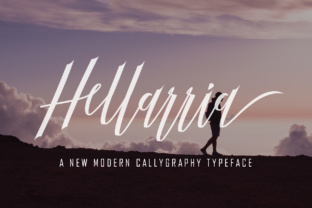
Hellarria Script is a modern script font designed to feel authentically handwritten—but with the polish and reliability you need for real-world branding. It’s not overly ornate or fussy. There are no dramatic flourishes that get lost on a 2-inch product tag, no fragile terminals that vanish when printed on kraft paper or viewed on a phone screen. Instead, it has soft, confident curves; balanced letter spacing; and subtle variations in stroke weight that give it warmth and rhythm—like someone wrote it with care, not haste.
What makes it especially useful for small businesses is its clarity. Unlike many script fonts that blur into illegibility below 14pt, Hellarria remains readable even at 10pt on matte-finish stickers or woven fabric tags. I tested it across three real applications: a café’s laminated menu board (printed at 24pt), a skincare brand’s 1.5-inch glass vial label (10pt bolded title + 8pt body pairing), and an online shop’s Instagram carousel headline (set at 36pt on mobile-optimized templates). In every case, it held up—clean, expressive, and unmistakably human.
Where Hellarria Script Shines Most
This isn’t a font you’ll want to use for paragraphs—or even full sentences on tight packaging. Hellarria Script is a display font, best suited for short, high-impact moments: your brand name on a logo lockup, the scent name on a candle jar, “Hand-poured” on a bakery box, or “Thank You” on a folded card tucked into a shipment.
- Logos & monograms: Its natural flow works beautifully as a primary logo, especially when paired with a clean sans serif for the tagline or contact info.
- Product labels & packaging: The lowercase “a,” “g,” and “y” have open, friendly shapes—ideal for readability on curved surfaces like jars or tubes.
- Social media graphics: It adds instant personality to quote cards, launch announcements, or seasonal promotions without competing with your photography.
- Printed collateral: From thank-you cards to event invites, it brings tactile warmth to digital-first brands.
One thing I appreciate: Hellarria Script includes stylistic alternates and ligatures—not as flashy extras, but as thoughtful refinements. A few well-placed connected letters (like “th” or “er”) smooth out rhythm in headlines, while alternate lowercase “a” and “e” options let you fine-tune tone—playful vs. refined—without switching fonts entirely.
Smart Pairings That Keep Your Brand Cohesive
No script font lives in isolation—and Hellarria Script thrives alongside intentional pairings. For most small business uses, I recommend pairing it with a warm, neutral sans serif: think Inter, Manrope, or Montserrat. These fonts ground Hellarria’s movement with quiet confidence. Use the script for your brand name or key phrase, and the sans serif for descriptions, ingredients, sizes, or contact details.
If your brand leans more editorial—say, a slow-living journal brand or a botanical tea company—you might pair Hellarria Script with a gentle serif like Cormorant Garamond or Playfair Display. Just keep the serif light or regular weight, and reserve Hellarria for top-level emphasis only.
Avoid pairing it with other scripts or overly decorative handwritten fonts—they compete for attention and dilute impact. And skip ultra-thin or ultra-bold sans serifs unless you’re going for deliberate contrast (e.g., a luxury candle line with minimalist black-and-white packaging).
Practical Things to Check Before You Use It
Before dropping Hellarria Script into your next design file, take two minutes to verify what’s included. As a commercial font, it typically comes in OTF and TTF formats—both work seamlessly in Canva, Adobe Creative Cloud, and Affinity apps. Look for:
- At least one weight (most versions include Regular + sometimes Bold or Italic)
- OpenType features like ligatures, stylistic sets, and discretionary ligatures
- Basic multilingual support (Latin-based languages, including accented characters used in French, Spanish, and German)
- A clear commercial license—especially if you’re selling physical products, creating client work, or bundling designs into digital templates
Also worth noting: Hellarria Script is a Script Handwritten typeface—not a variable font, and not built for body text. That’s not a limitation; it’s focus. It knows its role, and it performs it with quiet authority.
Why Typography Quietly Builds Trust
We don’t often talk about fonts as trust signals—but they are. A consistent, well-chosen script font tells customers: *This person paid attention. This matters to them.* When your candle label reads “Lavender + Sage” in Hellarria Script—not stretched, not pixelated, not mismatched with a clashing secondary font—it says you understand your craft *and* your audience.
That consistency ripples outward: same font on your website banner, same rhythm in your Instagram highlights, same warmth on your shipping box sticker. Customers begin to recognize your voice before they even read your words. And in a crowded marketplace—whether it’s farmers’ markets, Etsy shops, or local retail shelves—that recognition is everything.
Hellarria Script won’t fix pricing, packaging logistics, or customer service gaps. But it *will* help your brand look like the thoughtful, intentional, quietly confident business it already is—just with better typography.